
Introduction
Success does not always arrive with celebrity headlines, red-carpet appearances, or a recognisable public image. Sometimes, it begins in a laboratory, where researchers investigate materials so small that their properties challenge conventional ideas about electronics. Sometimes, it grows through an educational initiative designed to help girls see themselves as future scientists.
Dr. Maheera Abdul Ghani represents both sides of this story: scientific research and the effort to make science more accessible to the next generation.
A Pakistani materials scientist associated with the University of Cambridge, Ghani completed her PhD in materials science in 2025 and subsequently pursued postdoctoral research focused on ultra-thin semiconductors. She has also co-founded WinSci Pakistan, an initiative encouraging young people, particularly girls and women, to explore science and related fields. In 2026, she was recognised in Forbes’ 30 Under 30 Asia list in the Healthcare and Science category.
Her journey connects several important themes for modern women: international education, technical expertise, entrepreneurship, representation, and the responsibility to create opportunities for others.
For Zyvera, her story offers a different definition of influence—one built not primarily through public visibility, but through research, education, and the possibilities that scientific innovation may create.
Early Life and Educational Foundations
Publicly available biographies provide limited information about Ghani’s childhood and private family life. Her academic record, however, offers a clear picture of the foundations of her professional journey.
She studied Metallurgical and Materials Engineering at the University of Engineering and Technology (UET), Lahore, in Pakistan, completing her bachelor’s degree in 2019. During her undergraduate studies, she received recognition for academic performance, including a Pakistan Tobacco Company Gold Medal and recognition as a highest-CGPA achiever in her field.
She subsequently received an Erasmus Mundus Joint Master Degree scholarship and completed postgraduate studies in Advanced Functional Materials Engineering through Technische Universität Darmstadt in Germany and Grenoble INP in France. She completed this master’s-level programme in 2021, according to her University of Cambridge research profile.
These experiences gave her an academic foundation spanning materials engineering, advanced functional materials, and research environments across different European institutions.
International education can offer more than a qualification. It exposes students to different research cultures, technical approaches, academic expectations, and professional networks. For a scientist working in a rapidly developing technological field, this combination can be particularly valuable.
Ghani’s progression from engineering education in Pakistan to postgraduate study in Europe and doctoral research in the United Kingdom illustrates how a strong technical foundation can support a career across national and institutional boundaries.
Career Journey: From Materials Engineering to Advanced Research
Ghani’s career has centred on materials science, a discipline concerned with understanding how materials are structured, how they behave, and how their properties can be used in practical technologies.
Her early research experience included work involving transparent conductive electrodes, silver nanowire networks, polymer samples, and computational approaches to predicting the properties of two-dimensional materials. These projects introduced her to research questions relevant to electronics, materials engineering, and emerging device technologies.
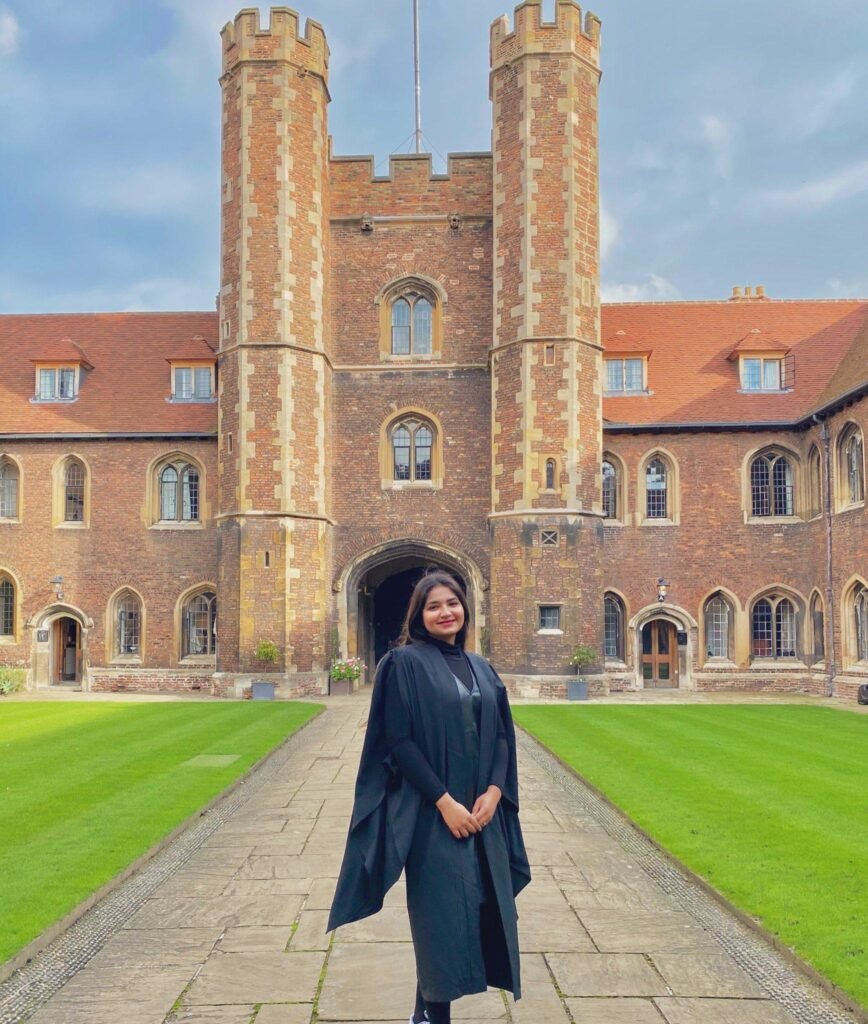
She later joined the Department of Materials Science and Metallurgy at the University of Cambridge, working within its 2D Materials and Devices Group.
Her doctoral research focused on two-dimensional materials and electronic devices. In 2025, she completed her PhD in materials science at Cambridge. Her subsequent postdoctoral work has focused on ultra-thin semiconductors and dielectric technologies for advanced electronic devices. These research areas are documented
Why ultra-thin semiconductors matter
Semiconductors are fundamental to modern electronics. They are used in the devices and systems that power computers, smartphones, communication technologies, and many other digital products.
As engineers seek to develop increasingly compact and capable electronics, researchers investigate materials that may offer useful electrical properties at extremely small scales.
Two-dimensional materials are particularly interesting because they can consist of layers only a few atoms thick. Their unusual properties may offer opportunities for future electronic devices, although practical applications depend on overcoming significant engineering and manufacturing challenges.
Dielectrics are another important part of this research. These insulating materials help control electrical behaviour within devices. Developing suitable dielectric materials and integrating them reliably with atomically thin semiconductors are important challenges for researchers working on next-generation electronics.
Ghani’s research sits within this broader scientific effort. It is specialised work, but it addresses questions that matter to the long-term development of electronic technologies.
Scientific progress is rarely the achievement of one individual working alone. It involves teams, experimental methods, repeated testing, collaboration, and the gradual accumulation of evidence. Ghani’s contribution should be understood within that research environment—and the complexity of the work makes her technical training particularly relevant.
Major Achievements and Recognition
Ghani’s professional record includes academic distinctions, research experience, science-education work, and international recognition.
1. A PhD from the University of Cambridge
Completing a doctorate in materials science at Cambridge in 2025 marked a significant milestone in her academic career. Doctoral research requires a sustained investigation of a specific problem, engagement with existing scientific literature, and the development and communication of original research.
The qualification also positioned her to continue working in advanced materials research.
2. Recognition in Forbes 30 Under 30 Asia 2026
In 2026, Forbes included Ghani in its 30 Under 30 Asia list under Healthcare and Science. The recognition highlighted her work on ultra-thin semiconductors and her contribution to encouraging women to pursue scientific careers through WinSci Pakistan.
The listing brought wider attention to a researcher whose work is primarily conducted in academic and technical environments rather than entertainment or conventional celebrity culture.
3. The Nature Inspiring Women in Science Award
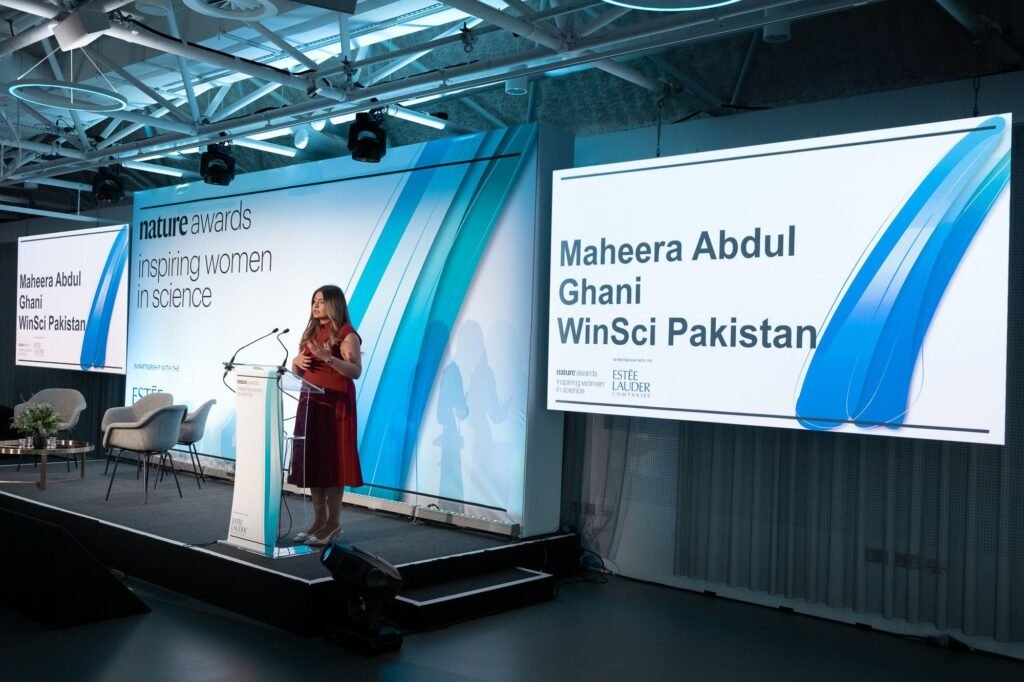
WinSci Pakistan received the Nature Inspiring Women in Science award from the Estée Lauder Companies and Springer Nature in 2025. The award recognised the initiative’s efforts to encourage women to pursue science.
This achievement is significant because it connects Ghani’s research career with a broader commitment to participation in science. Research expertise and educational outreach are different activities, but they can reinforce one another: a scientist can contribute to a technical field while also helping young people understand how to enter it.
4. A role in scientific innovation and entrepreneurship
Ghani has also been associated with Cambridge Dielectrix, a venture connected with dielectric technologies for two-dimensional semiconductors. Her Cambridge research group has identified her as a co-founder and CEO of the company.
This points to another possible dimension of scientific careers: moving knowledge beyond academic research towards technologies that may have commercial applications. Turning a promising research idea into a practical product, however, requires further development, testing, investment, and engineering.
Taken together, these milestones show a career developing across research, education, recognition, and technology entrepreneurship.
Leadership: Making Science More Accessible
One of the most distinctive parts of Ghani’s professional story is WinSci Pakistan, which she co-founded to encourage science education and participation among young people.
The initiative’s work focuses on making science more engaging, fostering curiosity, and creating opportunities for young people to explore scientific subjects. Its emphasis on encouraging girls and women to pursue science addresses a longstanding challenge: access to education and professional opportunities is not always distributed equally.
A young student may enjoy science but lack exposure to researchers, laboratories, university pathways, or careers in engineering and technology. Initiatives that make these possibilities more visible can help students understand that scientific careers are attainable and diverse.
Ghani’s involvement in this work demonstrates a form of leadership that extends beyond holding a professional title. It involves helping create an environment in which others can explore their interests and develop their own ambitions.
Her example also illustrates why representation matters. When students encounter women working in technically demanding fields, they gain a more concrete understanding of what a scientific career can look like. Representation alone cannot remove structural barriers, but it can challenge narrow assumptions about who belongs in science.
For aspiring leaders, the lesson is that expertise can become more valuable when it is shared. Leadership can mean developing a technology, guiding a research team, supporting an educational programme, or helping others find a path into a profession.
Luxury Lifestyle: Redefining What Success Looks Like
In a culture that often associates success with designer fashion, expensive travel, luxury homes, and high-profile social circles, Ghani’s career offers a different perspective.
There is limited reliable public information about her personal spending habits, possessions, or private lifestyle. It would therefore be misleading to invent details about the luxury products she uses, the places she visits, or how she spends her free time.
Instead, her professional journey invites readers to consider a broader interpretation of a successful lifestyle.
For a research scientist, professional resources can include access to advanced laboratories, collaboration with experienced researchers, opportunities to attend scientific conferences, and the freedom to investigate complex problems. These are not substitutes for personal comfort or financial success, but they can represent meaningful forms of professional opportunity.
Education, international experience, intellectual independence, and the ability to work on important problems can all contribute to a life shaped by purpose.
This does not mean luxury and scientific ambition are incompatible. It means that a person’s achievements should not be reduced to visible possessions. Ghani’s publicly documented career provides stronger evidence of her professional priorities than speculation about her private life would.
For Zyvera readers, this is a useful reminder: success can be measured by what a person builds, discovers, teaches, and makes possible—not only by what they own.
Personal Branding: Building Credibility Through Expertise
Ghani’s public profile demonstrates a form of personal branding grounded in specialised knowledge and measurable professional milestones.
Unlike a celebrity whose visibility may depend on entertainment releases or fashion campaigns, a scientist builds credibility through a combination of research, technical communication, collaboration, academic qualifications, and recognition from relevant institutions.
Three elements stand out in her professional story.
First, a clear area of expertise. Her work in materials science, two-dimensional materials, semiconductors, and dielectric technologies gives her professional identity a specific technical focus. Specialisation helps colleagues, institutions, and potential collaborators understand what a researcher works on.
Second, evidence of achievement. Her academic qualifications, research experience, and recognition through Forbes and the Nature Inspiring Women in Science award provide verifiable milestones. In technical fields, credibility depends on evidence rather than presentation alone.
Third, a wider professional purpose. Her involvement in WinSci Pakistan connects her scientific career with education and participation in STEM. It gives her public story a dimension beyond individual advancement.
These elements offer practical lessons for women building their own professional identities. A strong personal brand does not have to begin with a large social-media following. It can begin with developing a skill, documenting achievements accurately, communicating expertise clearly, and contributing consistently to a field.
For professionals in science, business, technology, and other specialised industries, credibility is often more durable than attention alone.
Inspiration: What Her Journey Can Teach Young Women
Ghani’s career offers several lessons for students and professionals who want to build meaningful careers.
Choose a field that rewards curiosity
Materials science brings together engineering, physics, chemistry, and technology. It is a reminder that many modern careers sit at the intersection of disciplines rather than within a single traditional subject.
Students do not need to know every detail of their future career at the beginning. Developing a strong foundation and remaining open to new questions can create opportunities to specialise later.
Build expertise step by step
Ghani’s academic progression included undergraduate engineering, postgraduate study in advanced materials, doctoral research, and postdoctoral work. Each stage built on earlier training.
There is no single educational route that guarantees success. Nevertheless, her journey shows the value of developing relevant skills and pursuing deeper knowledge over time.
Look beyond geographical boundaries
Her education and research experience span Pakistan, Germany, France, and the United Kingdom. International study is not the only route to achievement, and it is not equally accessible to everyone. However, her experience demonstrates how academic networks and opportunities across institutions can shape a professional journey.
Students can take a practical lesson from this: research programmes, scholarships, mentorship, internships, and collaborations are worth exploring when they align with their goals.
Connect personal progress with wider impact
Through WinSci Pakistan, Ghani has participated in work intended to encourage other young people to pursue science. This demonstrates that professional achievement and contribution to others can coexist.
Young professionals do not need to establish an organisation to make a difference. They can mentor a student, share reliable information, volunteer, support a community programme, or make their expertise more accessible.
Be patient with work that takes time
Research rarely produces immediate results. Experiments can fail, hypotheses may need revision, and promising ideas require repeated testing. A career in science therefore demands persistence as well as creativity.
The same principle applies to many other fields: lasting expertise is usually developed through consistent effort rather than one dramatic breakthrough.
Legacy: A Broader Vision for Women in Science
It is too early to define the full legacy of a scientist whose career is still developing. The long-term significance of Ghani’s research will depend on future scientific results, the technologies that may emerge from this work, and the continuing impact of her educational initiatives.
What can be said today is that her career connects two important priorities.
The first is scientific innovation. Research into advanced materials and ultra-thin semiconductors contributes to the wider effort to understand and improve the technologies on which modern society increasingly depends.
The second is access to opportunity. Through WinSci Pakistan, she has helped advance an initiative focused on encouraging young people, including girls, to explore science and develop their potential.
These areas address different challenges, but both look towards the future. Scientific research seeks to expand what humanity understands and can potentially build. Science education helps prepare the people who may make the next discoveries.
For women considering careers in engineering, technology, and research, Ghani’s professional path provides a real example of how academic training, international experience, specialised work, and community engagement can come together.
Her story is not a claim that every aspiring scientist must follow the same route. It is evidence that women can pursue highly technical careers while also contributing to broader conversations about education, representation, and innovation.
Lessons for the Next Generation
Dr. Maheera Ghani’s journey offers a practical set of principles for readers building their own ambitions:
- Invest in knowledge: Develop expertise that can stand up to professional scrutiny.
- Seek meaningful opportunities: Explore scholarships, research programmes, mentors, and collaborations.
- Make your work visible: Communicate achievements accurately and clearly.
- Support others: Use your experience to help make opportunities more accessible.
- Measure progress honestly: Distinguish demonstrated achievements from future possibilities.
- Define success for yourself: Look beyond public recognition and consider the value of the work you contribute.
These principles apply well beyond scientific research. They are relevant to women building businesses, entering technology, developing creative careers, or pursuing leadership in established organisations.
Conclusion
Dr. Maheera Ghani’s story is one of scientific ambition, international academic experience, and an interest in widening access to science education. From her engineering studies in Pakistan to doctoral research at Cambridge and recognition in Forbes 30 Under 30 Asia 2026, her professional journey demonstrates the value of sustained learning and specialised expertise.
Her involvement in WinSci Pakistan adds another dimension to that journey: the belief that progress can include helping others discover opportunities of their own.
As research into advanced semiconductors continues, the full impact of her scientific work remains to be seen. Her documented achievements already provide a meaningful example for young women considering careers in science, engineering, and technology.
Influence does not always require a stage or a spotlight. Sometimes, it grows through knowledge, careful research, and the opportunities one helps create for others.
My Life, My Achievements.